
PrintNews
PARTNER NEWS
From Managerial Bias to Collective Intelligence: How Evolutionary Selection Reduces Cognitive Biases
Date:
24. March 2026

Active equity funds often underperform due to cognitive biases and the structural limitations of individual decision-making. But what happens when collective intelligence is not merely aggregated, but evolutionarily selected? Dr Florian Berger of CoIQ.capital outlines how a
data-driven approach, based on more than 15 years of historical investment decisions can address the weaknesses of traditional active management, and why this approach is becoming increasingly relevant for asset managers.

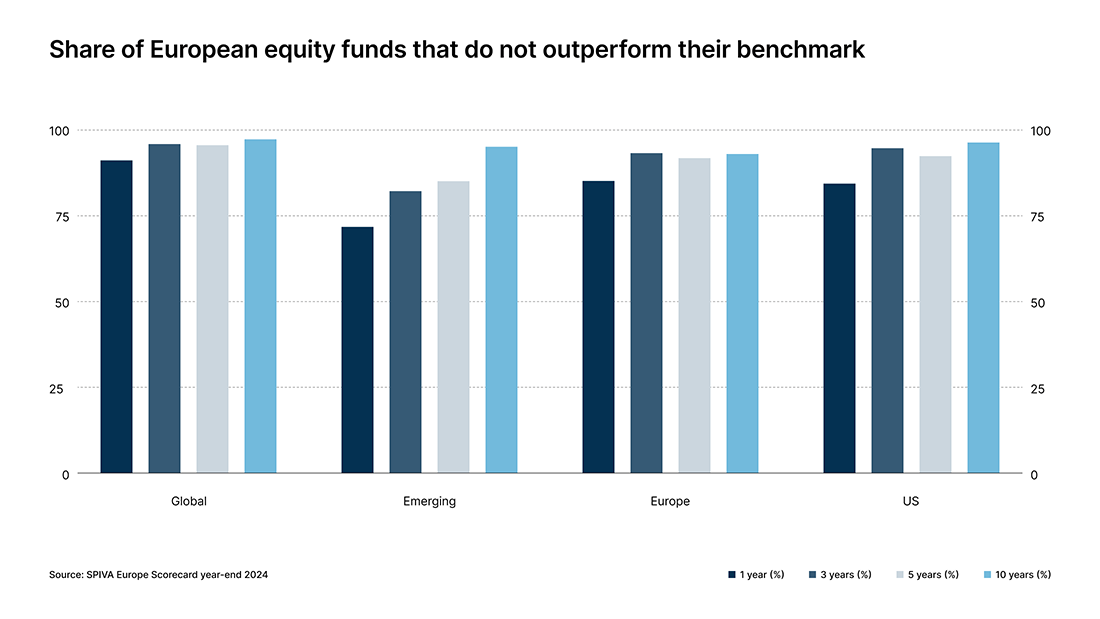
Numerous studies show that the majority of global equity funds underperform their benchmarks in the long term (see the 2024 SPIVA Europe Scorecard). Reasons for this include cognitive biases, structural incentive misalignments, and the inherent complexity of capital markets. Even experienced managers have limited capacity to process the vast amount of available information, which represents a structural limitation of individual decision-making processes.
At the same time, capital markets research indicates that long-term equity returns are disproportionately driven by a small number of highly successful companies (see Bessembinder, 2023). The challenge, therefore, lies in identifying at an early stage those stocks that contribute significantly to overall market returns — while minimising subjective intervention or situational biases, where possible.
Capital markets can be understood as dynamic systems. Every day, billions of individual transactions generate a decentralised price formation process that reflects the collective view of all market participants. Many investors therefore rely on global index strategies that passively capture this collective market intelligence and deliver average market returns over the long term.
A logical extension of this is that collective intelligence can be further refined if it is not only aggregated but subjected to evolutionary selection. Quantitative analysis of historical investment decisions can help identify robust patterns of success. Scoring models that objectively evaluate risk and performance over extended periods make it possible to identify investors who consistently generate above-average risk-adjusted returns.
Evolutionary selection in practice
In practice, evolutionary selection involves constructing portfolios based on the aggregated investment decisions of a select group of highly successful investors. One example of this approach is the CoIQ Collective Intelligence Fund (ISIN DE000A3C91C5, share class R).
The underlying data set comprises over 15 years of historical investment decisions from a large and diverse group of investors, providing a robust empirical foundation for evolutionary selection.
Regular adjustments to new signals create an adaptive system that incorporates both established success factors and current market developments.
Historical analyses suggest that the approach may outperform the benchmark over the long term, driven in part by stronger performance during bull markets.
A complementary approach for professional investors
The future of active equity strategies is unlikely to lie in expanding the information processing capacity of individual managers, but rather in the systematic use and refinement of collective intelligence. When implemented within a fund strategy, such an approach can serve as a complementary component in portfolio construction, aimed at improving risk-adjusted return profiles.
About CoIQ.capital
CoIQ stands for 'collective intelligence' and reflects the conviction that the collective wisdom of many can exceed the limited perspective of individuals.
Through informunity.de, CoIQ has operated a leading stock market simulation platform since 2010, with more than 65,000 participants.
The platform aims to quantify collective intelligence and identify individuals who are demonstrably able to outperform equity markets over extended periods. Through an evolutionary selection process, these individuals are identified, and their investment insights are made accessible for private and professional investors via the CoIQ Collective Intelligence Fund.
A summary of your investor rights in German can be found at https://www.universal-investment.com/en/Corporate/Compliance/Investor-Rights. We would also like to point out that Universal Investment, as the management company for funds for which it has made arrangements for the distribution of fund units in other EU member states, may decide to revoke these arrangements in accordance with Article 93a of Directive 2009/65/EC and Article 32a of Directive 2011/61/EU, in particular by making a flat-rate offer to repurchase or redeem all corresponding units held by investors in the relevant Member State.


